Jorbs recorded an Ascension 10 Silent run on March 12, 2026 with a one-HP start. His public run log lists it as run 67, reaching floor 50, with the note that he took no hits. The recording shows v0.98.3, so this is a historical run study rather than a current-patch deck prescription.
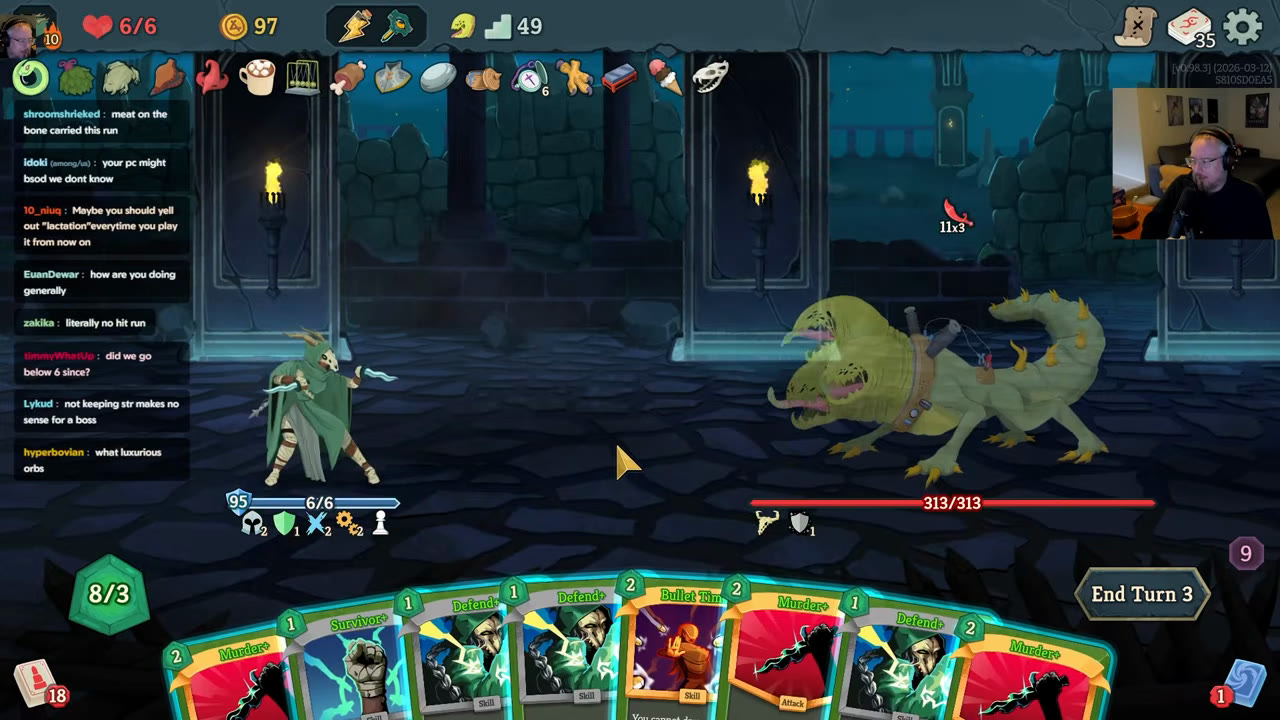
The useful question is how a deck protects a tiny HP pool while still finishing fights. At 85:00, the answer is visible: Silent has 6/6 HP and 95 Block against Test Subject’s displayed 11 × 3 attack. The defensive resource is already established before the enemy attacks.
Read the 85:00 position
| Visible resource | Value | What it establishes |
|---|---|---|
| Silent’s health | 6/6 | Max HP has risen above one by this point. |
| Existing Block | 95 | The displayed attack is covered before further card plays. |
| Enemy intent | 11 × 3 | Three separate hits, totaling 33 displayed damage. |
| Enemy health | 313/313 | A safe turn still needs to become a winning fight. |
| Hand | Survivor+, Defend+ copies, Bullet Time, Murder+ copies | Several options remain after the visible defense is established. |
Against that displayed attack alone, 95 Block exceeds 33 damage by 62. This calculation describes the pictured position; additional effects and subsequent phases need their own calculation. The hand does not establish which earlier plays produced all 95 Block.
Watching this position is more useful than copying a list of card names. Pause before ending a turn and compare the full attack sequence with protection that is already active. A large first hit and several smaller hits can require different answers when a defense prevents only one HP-loss event. The Buffer examples make that distinction explicit.
A one-HP start can finish above one Max HP
The 6/6 display separates this run from the Tablet of Truth challenge. That Badge requires winning with exactly one Max HP. Beginning at one, then gaining Max HP, does not satisfy the finishing condition.
Choose the objective before selecting rewards. In an ordinary low-HP recovery run, increasing Max HP can restore a margin for error. In a Tablet attempt, the same gain can invalidate the intended finish. A video headline about one HP does not settle which objective was completed.
The run log’s no-hits description also differs from the Perfect Badge, which counts qualifying boss fights. Avoid taking a run-wide description, a single combat frame and a Badge objective as interchangeable evidence.
Apply the defensive calculation to your own deck
Start with the enemy’s intent, then separate immediate protection from cards you still need to find. Survivor is usable when drawn; a card left in the draw pile cannot cover this turn’s deficit. Opening-hand consistency matters especially when there is no HP available to absorb a failed opening.
Current Bullet Time makes cards in hand free for the turn and prevents additional draw. Its order therefore matters: establish the intended hand before cutting off further access. That current rule is useful when planning a similar resource turn; it should not be used to reconstruct every play in a March recording without checking the historical version.
Keep offense in the calculation. Surviving an attack while an enemy remains healthy does not resolve future scaling, status cards or phase changes. Before spending the whole hand on damage, identify the defense for the next relevant attack. Before spending everything on Block, identify how the fight actually ends. The boss preparation guide covers that planning across encounters.
For a repeatable current Silent plan, use the discard build or Poison build as the starting point. This recording contributes a concrete example of an extreme defensive position, with its date and version attached.