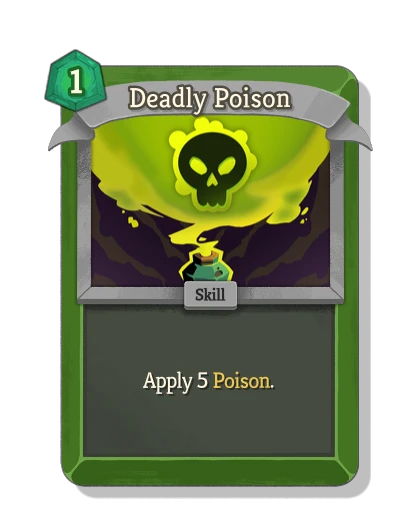
 Deadly Poison
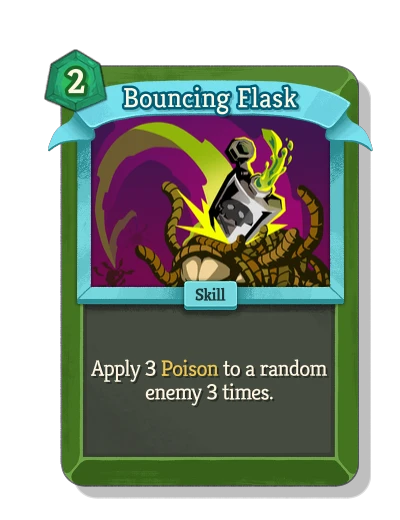 Bouncing Flask


Application and acceleration
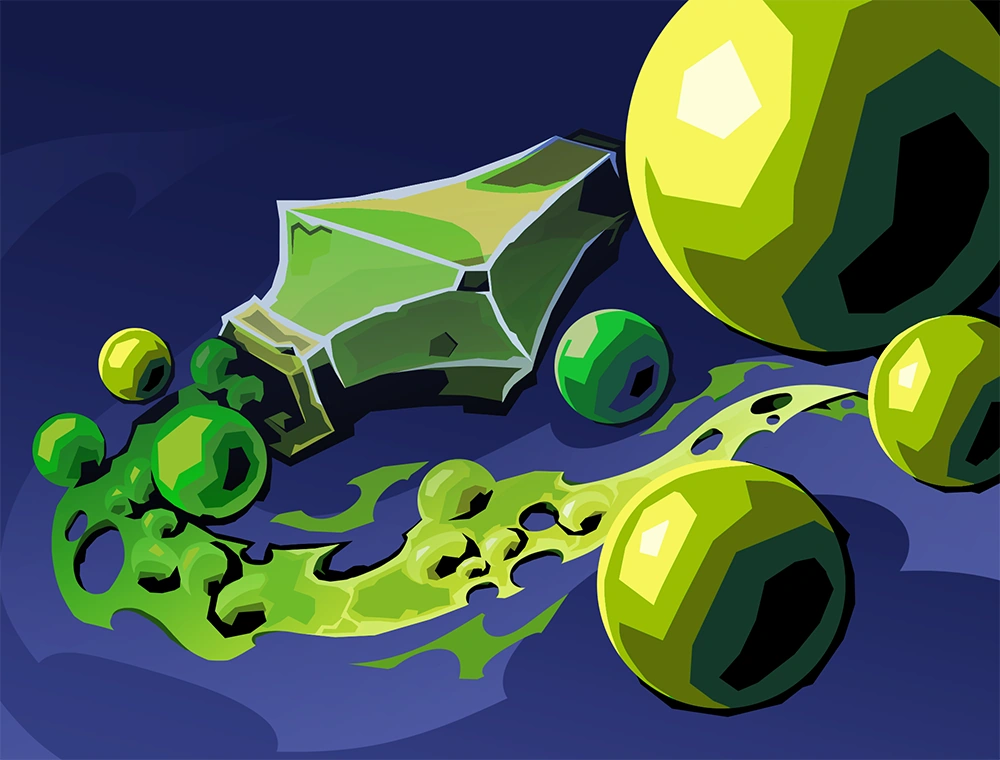
Deadly Poison supplies a direct application. Bouncing Flask applies Poison several times but chooses targets randomly, so a group can split its contribution. Noxious Fumes supplies recurring application to the enemy group. These cards establish a resource that later payoffs can use; a payoff without enough application may be a dead draw.
Accelerant triggers Poison additional times. Each trigger also reduces Poison, so faster damage spends the stack faster. It is not the same effect as multiplying a stack and leaving the larger amount in place. Keep the next few applications in view when judging whether it improves a long fight.
A small-stack counterexample
With only an unupgraded Noxious Fumes supplying two Poison per turn, an extra trigger can consume the same amount the Power adds. The result can stop the stack from growing. This does not make Accelerant inherently bad with Fumes; it means the pair alone is not an automatic scaling engine. A larger source such as Bouncing Flask changes that calculation.
Bubble Bubble requires Poison already on the target. Draw it before any application and its condition is missing. Mirage turns the enemy group’s Poison into Block, but only after those stacks exist. The same draw-order problem applies to both cards.
Draw, discard and hybrid turns
Acrobatics helps locate application, defense or a payoff. Haze has Sly, allowing a discard outlet to play it without paying the normal energy cost. Corrosive Wave rewards the act of drawing by applying Poison. These interactions let a discard engine supply a Poison win condition rather than forcing a choice between two unrelated decks.
Envenom needs attacks to deal unblocked damage. Outbreak needs repeated Poison applications. Buying or drafting both Powers is not enough when the deck lacks the attacks, draw or energy to use them. Count setup costs before adding another attractive synergy.
Upgrades and encounter needs
An application upgrade can be more valuable than another amplifier when stacks are small. A cycling improvement can be more valuable when the deck already contains enough Poison but finds it late. Leg Sweep and other dependable defensive cards buy time without requiring the entire engine to appear together.
Against multiple enemies, evaluate how quickly the dangerous target dies. Randomly distributed Poison and delayed damage may need an ordinary attack or area-damage card beside them.
Poison beside Grand Finale
An A10 community run paired Ghost Seed and Grand Finale with Bouncing Flask and Snakebite. The player reports that Poison finished Test Subject after several Finale plays and later Burn draws. This was a mixed damage plan: thinning the combat cycle did not remove the need for defense, potions or a second way to finish the fight.