The recorded deck
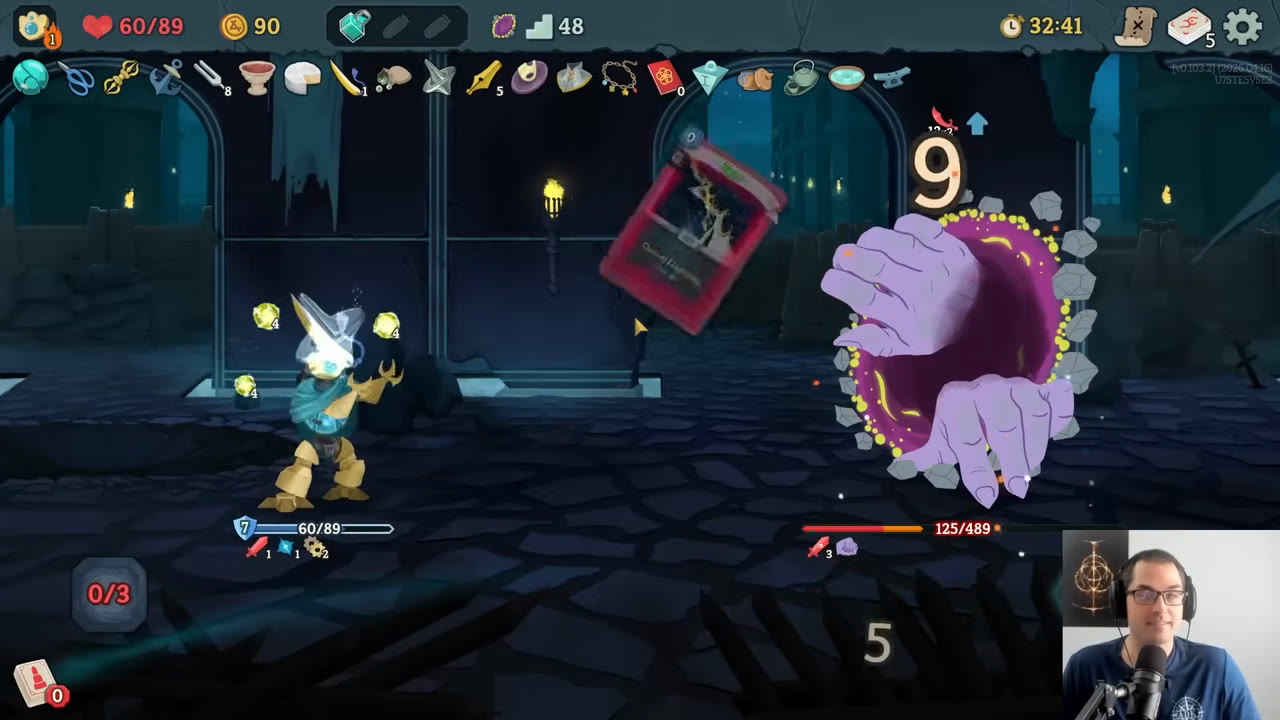
Baalorlord’s April 18, 2026 run finished on Ascension 1 with Darkness+, Dualcast+, Zap+, Shadow Shield+ and Defend+. The first three carried Swift 3. His run history records Precise Scissors at Neow, Letter Opener on floor 21, Unceasing Top on floor 26 and Data Disk on floor 29. It lists seven removals and a victory time of 32:53. The video’s late-combat frame supplies the visual context; the creator’s run history supplies the final deck.
This is a historical run study. Its deck size is useful evidence about one successful run, while the card and relic interactions below explain what to check when building a small deck today.
Fiddle changed the draw engine
The historical run-history tooltip gives Fiddle one additional card at the start of the turn. Current Fiddle draws two additional cards at turn start and prevents drawing during the turn. That restriction directly conflicts with the midturn draws requested by Unceasing Top and Swift. Copying the visible relic list into a current run does not recreate the same draw access.
| Current component | What it supplies | What it cannot supply |
|---|---|---|
| Unceasing Top | One draw when your hand becomes empty during your turn | Energy to play the drawn card; a draw through Fiddle’s restriction |
| Swift | Draws its stated number of cards on that card’s first play | A repeated draw trigger every time that card returns |
| Fiddle | Two extra cards at the start of each turn | Permission to draw during the turn |
Beautiful Bracelet supplies Swift 3 to three chosen cards. Swift 3 means three cards drawn on the first play; it does not mean a three-Energy discount. Keep that distinction separate from the genuine cost reductions on upgraded Zap and Dualcast. The energy and draw guide covers the two resources separately, and reshuffle timing explains why a draw request may see fewer cards than expected.
Five cards still need an Energy budget
Using current stable costs, upgraded Zap and Dualcast cost zero. Darkness costs one, upgraded Shadow Shield costs two, and upgraded Defend costs one. Playing all five once therefore costs four Energy before any other modifiers. That is already more than a normal three-Energy turn can pay.
A five-card opening gives access to the complete deck when no extra cards interfere. It does not give enough Energy to play everything. At three Energy, Darkness plus Shadow Shield uses the full budget; adding the zero-cost pair is affordable, while Defend still needs another Energy. Alternatively, Shadow Shield plus Defend spends three Energy on defense and channels a Dark Orb, leaving Darkness for another cycle or turn.
These are current-rules planning examples, not a reconstruction of the filmed turn. They show why an empty hand, enough draw and a small deck do not establish an infinite. A renewable loop needs a repeatable payment method as well as card access. The All for One loop guide applies that test to a different Defect package.
Darkness and Dualcast need the right Orb
Current Darkness channels a Dark Orb and triggers the passive abilities of all Dark Orbs; its upgrade triggers those passives twice. Existing Dark Orbs therefore benefit when another Darkness is played. Shadow Shield combines Block with another Dark channel. Those two effects give a compact deck a way to defend while preparing Orb damage.
Dualcast evokes the rightmost Orb twice. Check that position before playing it. A freshly channeled Orb, an older charged Dark Orb and a Lightning Orb offer different immediate damage. Repeated channeling can also push an Orb out of a full queue, spending its accumulated damage earlier than intended. A zero-cost card can still be wrong to play first.
For a simpler comparison, see the Lightning strategy; for a defensive Orb foundation, see Frost and Focus. The useful question is whether the current queue pays for the incoming turn, rather than whether the deck contains a particular Orb name.
Skill payoffs and defensive turns
Current Letter Opener deals five damage to all enemies every three Skills played in one turn. All five cards in the recorded final deck are Skills. In a hypothetical turn where all five are affordable, the first three Skills trigger one five-damage activation; five plays do not reach a second activation. Six Skill plays would. Keep the turn boundary in the count.
This gives small defensive cards an offensive contribution without turning them into Attacks. It also means a card’s direct text is only part of its value. A zero-cost Zap can advance the Skill counter while changing the Orb queue; a Defend can complete the counter while preserving HP. Order still matters when a channel or evoke would end the fight first.
Small decks are unusually sensitive to unwanted additions. A Status, Curse or enemy-imposed draw restriction occupies a larger share of the available hand. Consult Defect against Status cards before treating removal as a substitute for defense. Preserve a way to survive the turn when the hand is interrupted, and use the opening-hand guide to evaluate consistency beyond the clean five-card case.